A resale certificate request went out for a Costa Mesa condo this summer, the same one-page form that has moved through thousands of Orange County escrows without much drama. What came back was longer than it used to be. Tucked behind the CC&Rs and the current assessment statement was a structural inspection report, the kind that did not exist in these packets a year ago. Nobody on either side of the transaction had asked for it. It arrived because the law now requires the HOA to include it, not because a buyer's agent knew to go dig it up.
That single change, buried in a bill most homeowners have never heard of, is the reason this year's condo resales in Costa Mesa look different on paper than last year's did, even when nothing about the building itself has changed.
In this guide: What changed Jan 1 · The deadline confusion · Condo vs. not-a-condo · What the report protects · The financing angle · Escrow this fall · FAQ
What actually changed on January 1
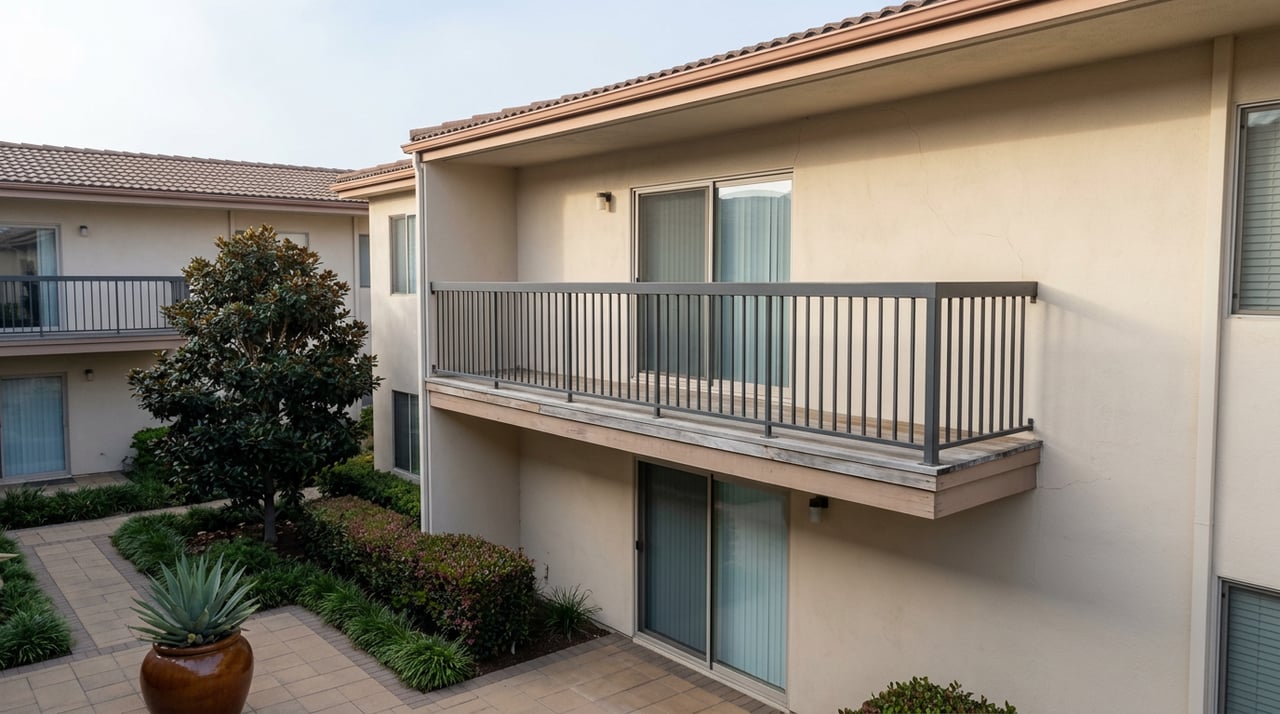
California's SB 326, codified as Civil Code section 5551, required condominium associations statewide to inspect their wood-supported balconies, decks, stairways, and walkways by January 1, 2025. That deadline has already passed. What changed this year is not the inspection requirement itself but what happens to the paperwork after the inspection is done.
Senate Bill 410 took effect January 1, 2026, and amended Civil Code section 4525, the statute that spells out everything a seller's resale certificate must contain. Before SB 410, an HOA had to disclose that a Section 5551 inspection had occurred if a buyer or their agent asked the right question. Now the association has to hand over the actual inspection report as a standard line item in the resale package, the same way it already discloses current assessments, pending litigation, and reserve fund status. The report is no longer something a diligent buyer's agent tracks down. It is something the seller's association is required to produce.
For a Costa Mesa condo buyer, that turns a document most people never saw into something sitting in the same stack as the title report and the preliminary title commitment.
The deadline confusion still working its way through boards
Here is where the timing gets genuinely confusing, and where a lot of Orange County HOA boards have gotten it wrong in public notices sent to their own homeowners.
Many boards spent late 2025 and early 2026 telling residents they had until January 1, 2026 to complete their balcony inspection, citing a deadline that does not apply to them.
That January 2026 date belongs to a different law. SB 721, governed by Health and Safety Code section 17973, covers rental apartment buildings, not HOA-run condominiums. Assembly Bill 2579 pushed the SB 721 apartment deadline out by a year, to January 1, 2026, but it explicitly left condominium associations out of that extension. The SB 326 deadline for condos never moved. It was January 1, 2025, and it still is.
The practical result for a Costa Mesa buyer is that an association telling you its inspection is "on schedule for the 2026 deadline" is telling you it is already well over a year late, whether the board realizes it or not. Under the resale certificate rule that took effect this year, that lateness now shows up as an absence in the paperwork rather than something you would have had to catch on your own.
Not every Costa Mesa "condo" is legally a condominium
The word condo gets used loosely in Costa Mesa listings, and that looseness matters more this year than it used to. Civil Code section 5551 applies specifically to condominium projects, defined under section 4125 as developments where an owner holds a separate interest in airspace plus an undivided interest in the common area, with three or more attached units per building and wood-framed elevated elements above six feet. It does not apply to planned developments, where individual owners actually own the structure they live in, even if the community looks and feels identical from the street.
Costa Mesa's attached housing stock runs through both structures. Places like College Park's various phases, Newport Landing, Wilson Park Condos, Spinnaker Cove, and Mesa Verde's collection of condo and villa communities sit alongside townhome-style planned developments carrying similarly residential names. From the sidewalk, a two-story building with private balconies looks the same whether it is legally a condominium or a PUD. The governing structure underneath is not the same, and it decides whether a Section 5551 report exists for that building at all.
Structure type | Subject to SB 326 / SB 410 disclosure? | What that means in escrow |
|---|---|---|
True condominium (Civil Code 4125), 3+ attached units, wood EEE over 6 feet | Yes | Resale certificate must include the actual inspection report, a requirement in effect since January 1, 2026 |
Planned development / townhome association, owner owns the structure | No | No statutory inspection or report exists; balcony condition is not covered by this disclosure regime at all |
Newer construction (certificate of occupancy after 2020) | Yes, on a different clock | First inspection due within six years of the certificate of occupancy, not the universal 2025 date |
The second row is the one worth sitting with. A planned development isn't exempt because it is safer. It is exempt because no state law requires anyone to have looked at the wood underneath those balconies on any schedule at all. For a buyer, "no report in the packet" can mean two very different things, and the resale certificate alone will not tell you which one you are looking at. That is a question for the HOA's management company or board before you assume either way.
What a missing report is actually protecting you from
The money at stake is why this disclosure line item matters more than a compliance checkbox. Industry reporting on balcony inspections statewide has put typical repair costs at $10,000 to $25,000 per balcony once dry rot, termite damage, or a failed waterproof membrane turns up, and at least one attorney quoted in that same reporting cited a $175,000 per-unit special assessment as the largest he had personally seen tied to balcony remediation.
California HOA boards do not need a homeowner vote to levy some of that. Under Civil Code section 5605(b), a board can impose special assessments totaling up to 5 percent of the association's budgeted gross expenses for the year without putting it to a membership vote. Anything beyond that threshold generally requires owner approval, except in a narrow set of emergency circumstances tied to court orders or an immediate safety hazard.
A resale certificate that includes a clean, current Section 5551 report is telling you the association already absorbed this risk before you showed up. A certificate with no report, or one that's several years stale, is telling you the risk is still sitting in the building's future, and you would be buying into it at closing rather than reading about it after.
The financing angle most buyers don't see coming
There's a second consequence that has nothing to do with the physical balcony and everything to do with getting a loan. Fannie Mae and Freddie Mac tightened condo project eligibility standards after the 2021 Surfside collapse in Florida, and both now weigh deferred maintenance and structural inspection compliance when deciding whether a condo project qualifies for conventional financing. Fannie Mae maintains a list of condo projects it will not lend against, and industry reporting has described that list growing by 200 to 400 associations a month nationally. Freddie Mac doesn't publish an equivalent public list, but a lender still has to run the building through Freddie's own Project Assessment Request before your loan can close.
A Costa Mesa condo with a lapsed or incomplete SB 326 report is not just a disclosure gap. It's a building that may not clear a conventional lender's project review, which narrows the buyer pool to cash offers and non-conforming financing regardless of how the unit itself shows.
Buying or selling an attached home in Costa Mesa this fall? The Costa Mesa market update shows what condos are actually trading for, and my coming soon alerts flag new listings before they reach the portals.
What this means for an escrow this fall
If you're buying a condo in Costa Mesa right now, the resale certificate is worth reading before you read the inspection report on the unit itself. Confirm whether the community is a true condominium under Civil Code 4125 or a planned development, since that determines whether a Section 5551 report should exist at all. If it is a condominium, check the report's date against the January 1, 2025 deadline, not the 2026 date many boards still cite. If the building was completed after 2020, check its certificate of occupancy date instead, since its six-year clock runs on a different schedule.
If you're selling, get ahead of this before you list. A resale certificate that shows up incomplete mid-escrow costs you leverage you would have kept by handling it up front.
Frequently asked questions
Does this apply to every condo in Costa Mesa?
No. It applies only to buildings that are legally condominium projects under Civil Code 4125, with three or more attached units and wood-framed elevated elements above six feet. Planned developments and townhome associations where owners own the structure fall outside the law entirely.
If my HOA already inspected balconies years ago, does that count?
It depends on when and how. The statutory first-inspection deadline for most existing buildings was January 1, 2025. After that, Section 5551 requires a repeat inspection every nine years, so an association that met the 2025 deadline is not due again until 2034.
Is there a daily fine for a non-compliant HOA?
Not under Section 5551 itself. The $100 to $500 per-day penalty some sources cite belongs to the separate SB 721 apartment law under Health and Safety Code 17973, not to condominium associations. That does not mean there is no exposure. It shows up instead through liability, insurance underwriting, and lending eligibility.
What if my building was built after 2020?
Newer construction gets a different first-inspection deadline, six years from the certificate of occupancy, rather than the universal January 1, 2025 date that applies to older buildings.
Costa Mesa's condo inventory is varied enough that two buildings a block apart can be governed by completely different rules on this. If you're buying or selling an attached property here this fall, that's exactly the kind of contract detail worth walking through before you're already under a deadline in escrow. Jade Larney works these transactions across Costa Mesa and the surrounding coastal market and can help you read a resale certificate for what it actually says before you sign anything.
A note from Jade
Every home in coastal Orange County prices a little differently, and this month's market moves faster than online estimates. If you are weighing a sale, I will put together a personal home value review for your address, built on the recent sales that actually compare.